Monaco Yacht Show 2026: Bigger, Busier and More Exciting Than Ever
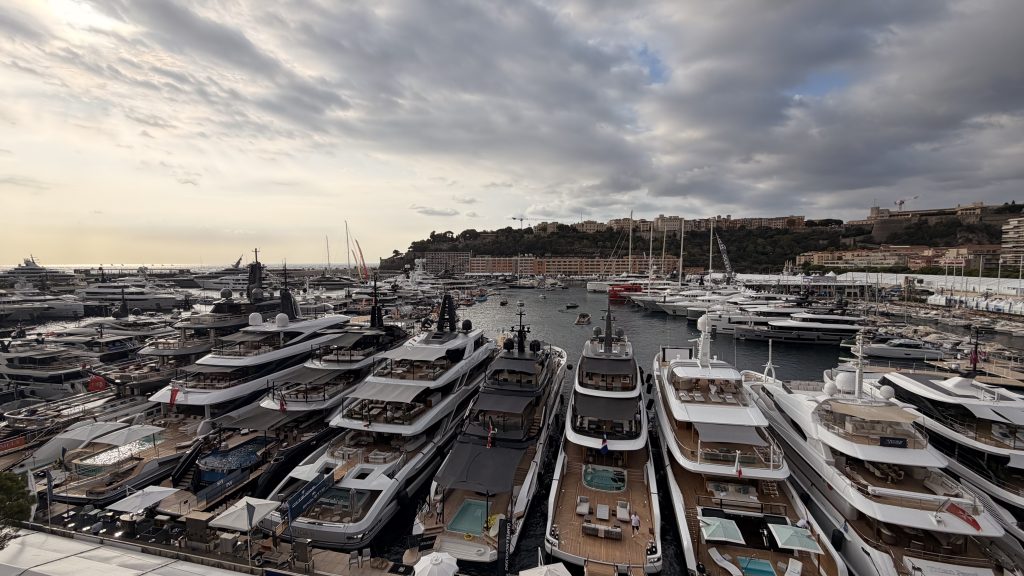
From 111-metre Oceanco Leviathan to solar-electric Sunreef catamarans, high-performance sailing yachts and a new generation of sub-500 GT motor yachts, Monaco demonstrated just how many different answers there are to one deceptively simple question: what does freedom on the water look like?
Every year I leave the Monaco Yacht Show thinking it cannot possibly get any busier. And every year, somehow, it does.
Monaco is never simply about walking the docks and looking at yachts. For Lomond Yachts, this year’s show meant juggling appointments with clients, meeting shipyards and brokers, catching up with old friends from across the industry and, importantly, spending time getting to know new clients and understanding exactly what they are looking for.
That last part matters. A yacht that looks spectacular on paper can be completely wrong for the person who is going to own it. Understanding how someone wants to use a yacht, where they want to go, who will be travelling with them and what matters most once they are aboard is far more important than simply starting with a list of yachts for sale.
Against that background, the sheer variety at Monaco this year was striking. There was no single definition of what the modern superyacht should be. Instead, the show offered radically different interpretations of luxury, performance, volume, technology, sustainability and adventure.
At one extreme stood Oceanco’s 111-metre Leviathan, a yacht whose scale moves the conversation beyond conventional yacht design and into the territory of floating architecture. At the other were yachts such as the Grand Soleil 80, where the attraction remains something much more elemental: the pleasure of actually sailing.
And between those extremes was almost everything imaginable.
The 499 GT sweet spot
One of the most interesting themes was the continuing sophistication of yachts designed around the sub-500 GT threshold.
Tankoa provided some excellent examples. The 55-metre Loewe, designed inside and out by Luca Dini Design & Architecture, manages to accommodate six guest cabins while remaining at 499 GT. An owner’s suite with its own Jacuzzi terrace is joined by a beach club incorporating a swimming pool, sauna and hammam, while Tankoa’s underwater-facing Nemo window creates an unusual connection with the sea.
At an asking price of €38 million, Loewe also makes an interesting comparison with some considerably larger-volume yachts. She demonstrates how sophisticated the market immediately below 500 GT has become, with owners no longer necessarily having to choose between manageable dimensions and serious superyacht amenities.
Tankoa’s 45-metre Singolare pushes the same philosophy even further. At approximately 495 GT, she demonstrates just how much usable yacht can now be packed into a relatively compact length. Her upper deck becomes a dedicated wellness and entertainment level with gym, sauna and private cinema, while a climate-controlled veranda, elevator, floor-to-ceiling wine cellars and concealed tender garage reinforce the impression of a yacht substantially larger than her 45 metres might suggest.
Then there was Spirit, the 51.5-metre Tankoa T52 Vitruvius and one of the technically fascinating yachts at Monaco. Philippe Briand’s Vitruvius Yacht Design created the naval architecture and exterior around more than 250 square metres of exterior terraces and folding platforms. More significantly, Spirit employs full-hybrid propulsion combining conventional engines, electric motors and batteries.
This is where hybrid technology becomes more interesting than simply attaching an environmental label to a yacht. Electric operation, battery capacity and intelligent energy management can contribute to quieter anchorages, reduced generator use and a fundamentally different experience aboard.
Italian style, at a very different scale
Riva offered another interpretation of the modern motor yacht.
The 40-metre Lady First, a Riva 130 Bellissima, combines the unmistakable styling of Officina Italiana Design with a semi-displacement platform capable of approximately 22 knots. At 299 GT she remains relatively compact in regulatory terms, yet still manages three decks, accommodation for ten guests and a 60-square-metre, three-level beach club.
The new Sairu takes the Riva proposition considerably further. The first Riva 54Metri and the largest Riva yet built when delivered, the 54.84-metre all-aluminium yacht remains at 499 GT while providing four decks, a beach area of more than 60 square metres and a sundeck exceeding 100 square metres.
Sairu is interesting because she isn’t simply an enormous version of a fast Riva. With an approximately 11-knot cruising speed and 18-knot maximum, this is a different proposition: Riva design language translated into a genuine displacement-superyacht lifestyle.
Volume versus length
Perhaps one of the most useful conversations to have with any prospective owner is whether they are really buying length or buying usable space.
Pa’Lante, Heesen’s latest 55m Steel, makes the point beautifully. At around 760 GT, she offers substantially greater volume than 499 GT yachts of broadly comparable length, together with a 4,500-nautical-mile range. Her interior by Luca Dini also moves away from the pale minimalist aesthetic that has become ubiquitous aboard modern superyachts, instead drawing on marine mahogany, deeper woods and references to the J-Class era.
Then there is the 61.5-metre Sanlorenzo Lemon Tree. At an extraordinary 1,280 GT, with an 11.5-metre beam, seven guest cabins, dedicated owner’s deck, two swimming pools, cinema, elevator and substantial beach club, she demonstrates how misleading length alone can be when comparing yachts.
The same argument applies further down the size range. Horizon’s FD100 manages 217 GT in just under 31 metres, with a substantial 7.25-metre beam, main-deck owner’s suite, four further ensuite guest cabins, upper-deck skylounge, tender garage and hydraulic bathing platform.
For an owner who wants generous interior volume without the operational implications and marina footprint of a 40 or 50-metre yacht, that becomes an increasingly persuasive proposition.
And sometimes speed still wins
Not every owner wants maximum volume, silent cruising or long-range displacement performance.
The 49.87-metre Rossinavi Flying Dagger III remains an exhilarating counterargument. Three MTU engines driving three Rolls-Royce/Kamewa waterjets give her a maximum speed of around 31 knots and a 24-knot cruising speed.
Yet she still provides 495 GT and accommodation for ten guests.
There is something wonderfully uncompromising about that. Yacht design may be talking increasingly about efficiency, range and electrification, but sometimes the brief remains refreshingly simple: go fast.
Catamarans come of age
One of the clearest changes in the market is the increasing importance of catamarans. They are no longer a peripheral alternative to the conventional superyacht.
Sunreef has played a major part in that transition, and the new Ipharra II, the first Sunreef 100 Eco, provided a compelling demonstration of where the sector is heading.
At 29.37 metres, her length tells only part of the story because the catamaran platform produces enormous beam and usable living space. More interesting still is the technology beneath it. Approximately 242.5 square metres of integrated solar panels feed a 770kWh battery bank powering twin 360kW electric motors.
Solar-electric propulsion allows harbour manoeuvring and periods of operation without conventional diesel propulsion, while the huge battery capacity changes the way energy can be managed throughout the yacht.
For buyers coming into yachting today, particularly those less attached to traditional definitions of what a superyacht ought to look like, the combination of space, stability, efficiency and technology makes increasingly compelling sense.
My Monaco programme with Sunreef went considerably beyond inspecting the yachts. I had the opportunity to speak with Francis Lapp, the French entrepreneur who founded the Gdańsk, Poland-based shipyard, while Senior Sales Manager Alexandra Tovar looked after my client during his visit and spent time exploring his requirements.
That relationship continued on Thursday evening when my client was a personally invited guest at Sunreef’s exclusive owners’ party, reflecting his serious interest in potentially becoming one of the yard’s owners.
Held poolside, it was one of those unmistakably Monaco evenings. Champagne hosts circulated wearing glasses incorporated into their dresses, and the party continued until dawn. Yet behind the spectacle was something more important: the opportunity for existing and prospective owners to spend time with the people behind the yachts in a much more relaxed environment.
Sunreef has also created an extraordinary circle around the brand. Rafael Nadal, Fernando Alonso, Nico Rosberg, Paris Hilton and Carlos Alcaraz are among the famous names associated with Sunreef, and another extremely well-known figure is expected to join their ambassadors following the completion of a significant deal.
For Lomond Yachts, Monaco was also the beginning rather than the end of our work together. Lomond Yachts and Sunreef will be bringing a series of exclusive dinner events to London in the new year for selected private clients interested in owning a Sunreef yacht.
These evenings will provide a rather different environment from a major international yacht show: an opportunity to meet, understand the yachts and discuss individual ownership requirements privately over dinner.
SilverCAT and a different kind of catamaran
If Sunreef demonstrates how the luxury catamaran has moved firmly into superyacht territory, Silver Yachts showed another interpretation altogether.
The yard was exhibiting SilverCAT, sistership to Reduce, the SilverCAT owned by the founder of Silver Yachts. That created a particularly nice sense of continuity for me, having been aboard Reduce with him last year.
The SilverCAT concept demonstrates why it is increasingly misleading to think of large catamarans simply as alternatives to monohulls. The platform opens possibilities around stability, efficiency, extraordinary deck areas and internal volume that produce a very different ownership proposition.
Silver Yachts itself has long been prepared to challenge established superyacht thinking. Its distinctive aluminium yachts combine slender, efficient hull forms with serious range and a more purposeful aesthetic, appealing to owners who increasingly see a yacht as a means of travelling extensively rather than simply moving between the familiar Mediterranean anchorages.
Monaco also provided the opportunity to catch up with Rod Davies, Silver Yachts’ Yard Director, aboard SilverCAT. And, this being Monaco, the yacht inspection once again transitioned into a party.
That combination of business and longstanding relationships is one of the aspects of Monaco I value most. You can spend the afternoon discussing yacht design, construction and an owner’s requirements, then find yourself that evening sharing a drink with the people actually responsible for building the yachts.
ShadowCAT and the support revolution
Not every catamaran is designed primarily around owner and guest accommodation.
ShadowCAT reflects another increasingly important part of the superyacht market: purpose-built support vessels.
As owners ask their yachts to carry more toys, tenders, diving equipment, submersibles, helicopters and specialist equipment, the traditional approach of trying to squeeze everything into the mothership begins to impose compromises.
A dedicated support catamaran changes that equation. It allows the principal yacht to remain focused on the owner, guests, accommodation and lifestyle while moving much of the operational hardware elsewhere.
For owners with genuinely adventurous programmes, that can be far more intelligent than simply building an ever-larger conventional yacht. It is another example of the diversification taking place within the market and another reason why simply comparing yachts by length tells us increasingly little about their intended purpose.
Sailing is having its own technological revolution
It would be easy amid the pools, beach clubs and enormous motor yachts to overlook the sailing yachts at Monaco. That would be a mistake.
The Grand Soleil 80 represents one end of the spectrum: a large performance cruiser for an owner who still wants the experience of sailing rather than a superyacht that happens to have a mast. At 26.2 metres, the emphasis remains on performance and blue-water capability, with carbon reinforcement and a design intended for an owner who wants to participate in the sailing experience.
The 38.98-metre Raijin, the second Swan 128, takes the concept much further. German Frers naval architecture is combined with Swan’s Dual Energy technology, developed with Danfoss, using a diesel-electric arrangement designed to increase energy self-sufficiency while under sail and reduce conventional generator dependency.
Then there was Magic, the 44.3-metre Vitters fast cruising sloop. Designed by Reichel/Pugh, she combines serious sailing credentials with contemporary superyacht living. A glass-intensive superstructure provides near-360-degree views, the transom opens into a substantial beach club and technical features include peak-shaving battery technology and Vitters’ twin V-drum sail-handling system.
For a very different interpretation of sailing, Grace III combines J-Class-inspired lines with modern aluminium construction and contemporary underwater architecture. She looks back to the golden age of sailing yachts without asking her owner to accept century-old technology.
And Monaco also demonstrated the continuing appeal of the great Perini Navi fleet.
The 48-metre Belle Brise, originally launched in 1993, has undergone such an extensive reconstruction between 2023 and 2026 that she presents an unusual alternative to commissioning a new yacht. Meanwhile the 52.34-metre Squall, following approximately €3.5 million of refit investment completed this year, illustrates another route into substantial sailing-yacht ownership: acquire a proven platform after somebody else has undertaken the expensive work.
The common thread through all of them is that large sailing yachts are not standing still technologically. Energy management, battery systems, advanced sail handling and sophisticated construction are changing the experience while preserving the fundamental reason their owners choose them in the first place: they want to sail.
Friends, relationships and thirteen years with Lürssen
The social side of Monaco Yacht Show can look like pure theatre from the outside, and there is certainly plenty of that. But these gatherings serve a genuine purpose in an international industry built heavily around personal relationships and trust.
And then there is Lürssen.
One of the pleasures of Monaco each year is catching up with everyone’s best friend and one of the industry’s true gentlemen, Michael Bremen, Lürssen’s Sales Director.
I have known Michael for many years and our Monaco catch-ups have become something of a tradition. Sometimes I arrive with an interested client. This year my clients happened to be looking for something different, which is simply the nature of being an independent buyer’s adviser. The requirement comes first and the yacht and shipyard have to fit it, rather than the other way around.
What I particularly value is that Lürssen has been supportive of Lomond Yachts from the very beginning.
Lomond Yachts was formed in 2013, and that same year I made my first visit to Lürssen. My introduction to this extraordinary end of the industry rather memorably concluded at a party aboard the 88-metre Quattroelle.
Thirteen years later, the yachts may change and clients’ requirements certainly do, but friendships endure. Michael remains one of those people seemingly everyone in the industry knows and is pleased to see, and it was a pleasure to catch up with him again.
Lürssen then provided one of the great finales to the week on Saturday night, hosting an evening with Madness performing live.
There cannot be many industries where a day discussing yacht design, construction, propulsion systems and client requirements can finish with one of Britain’s best-known bands performing in Monaco.
But that is Monaco Yacht Show. The yachts bring everyone there, but the relationships are what bring you back.
The 111-metre reminder
And then there was Leviathan.
At 111 metres, the Oceanco yacht provided a useful reminder of just how far the word “yacht” can now stretch.
At this scale, simply adding metres misses the point. Crew operations, aviation, tenders, engineering, energy generation, security, privacy and logistics become design disciplines in their own right. These vessels are not merely scaled-up 50-metre yachts. They are extraordinarily complex private maritime environments.
The sheer comparison is fascinating. Leviathan is more than four times the length of the Grand Soleil 80, yet both belong at the same Monaco Yacht Show and both ultimately exist to provide their owners with freedom on the water.
Seeing something of that scale in the same show as an 80-foot performance sailing yacht is precisely what makes Monaco fascinating.
The right yacht is different for everyone
After a week aboard such radically different yachts, one conclusion becomes difficult to avoid: there has probably never been more choice for an owner.
You can have 31 knots aboard Flying Dagger III, extraordinary volume aboard Lemon Tree, classic-inspired sailing aboard Grace III, cutting-edge performance aboard Magic, hybrid propulsion aboard Spirit, solar-electric catamaran cruising aboard Ipharra II or the distinctive multihull philosophy of SilverCAT. For owners whose ambitions extend still further, the expedition thinking behind Silver Yachts and the support-vessel approach of ShadowCAT open up entirely different possibilities.
None is intrinsically the right answer.
The right answer depends on how an owner intends to use the yacht, where they want to go, who will travel with them and what they actually enjoy doing once they get there.
That is why Monaco for me was ultimately less about collecting specifications and more about conversations. Between yacht visits I was juggling clients, meeting old friends and getting to know new clients and their requirements. Understanding those requirements is where the real work begins.
A specification sheet can tell you the range, gross tonnage, number of cabins and maximum speed. It cannot tell you whether somebody will love owning the yacht.
By the end of the week, Monaco had once again delivered what it does better than anywhere else: extraordinary yachts, extraordinary technology, longstanding friendships, new relationships, a little excess, plenty of champagne and an entire industry compressed into a few hectic days around Port Hercule.
For Lomond Yachts, it was a hugely successful show. We came away with new client opportunities, strengthened relationships with some of the world’s most interesting shipyards and, through our developing partnership with Sunreef, plans to bring some of that Monaco experience back to London for prospective owners in the new year.
Each year it gets busier. Each year the yachts become more interesting. And each year I seem to leave Monaco more excited about what comes next.
The right yacht. The right advice.