Cockwells, Riva or Hinckley? Three Exceptional Boatbuilders, One Difficult Decision
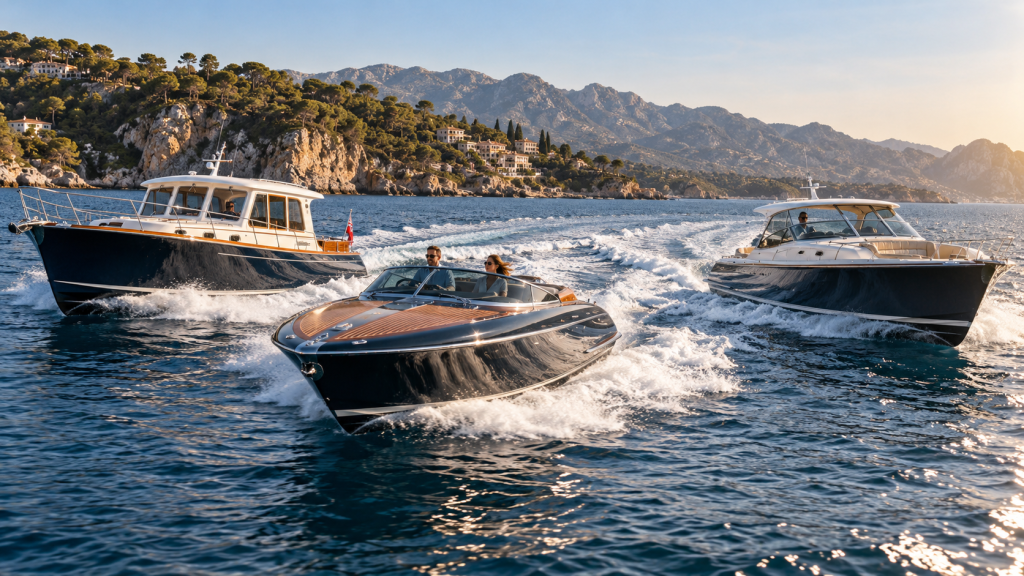
British craftsmanship, Italian glamour or American innovation? Choosing between three distinctive names in luxury motor boating is far more complicated than deciding which looks best in the marina.
Recently, I found myself considering three rather different boatbuilders: Cockwells, Riva and Hinckley. Each has a compelling story, a recognisable design philosophy and a loyal following. Each produces boats that can turn heads in a marina and make an owner feel they have purchased something rather special. Yet the more closely you look, the harder the choice becomes.
At first glance, this might appear to be a contest between British craftsmanship, Italian elegance and American engineering. In reality, that barely scratches the surface. Choosing the right boat involves an extraordinary number of personal decisions, some obvious, others surprisingly obscure. Speed, fuel consumption, draft, handling, delivery times, purchase price, maintenance, weather protection and overnight accommodation all matter. So might the position of the drinks refrigerator, the availability of air conditioning or whether guests can comfortably sit together while underway.
And then there is the most unpredictable consideration of all: what the customer actually wants.
Three exceptional boats can be equally desirable while satisfying three completely different sets of priorities. That is what makes this comparison interesting, and why declaring a single winner would rather miss the point.
Three Builders, Three Different Philosophies
Cockwells: British craftsmanship and practical elegance
Cornwall-based Cockwells Modern & Classic Boatbuilding combines traditional British craftsmanship with contemporary engineering. Its Duchy range has an unmistakably classic character, with graceful lines, beautiful joinery and an emphasis on making time aboard genuinely enjoyable.
The Duchy 35 is a particularly interesting example. At approximately 11.5 metres, it offers flexible accommodation, a comfortable wheelhouse, galley facilities and options including air conditioning, a generator and stabilisation. Depending on the engine configuration, maximum speeds are quoted between 28 and 32 knots, while its relatively shallow draft of approximately 0.89 metres makes it attractive for coastal cruising.
The appeal is not simply aesthetic. Enclosed accommodation, protection from the elements and the opportunity to personalise a boat around individual requirements can make Cockwells particularly attractive to owners who expect to use their vessels regularly in varying conditions. Its wider range also includes smaller launches and more performance-oriented designs.
However, craftsmanship and personalisation bring their own considerations. Custom specifications can affect purchase price and delivery schedules, while a buyer seeking a highly individual boat may have to accept a longer wait than someone purchasing an available vessel.
Riva: Italian glamour and unmistakable style
Few boatbuilders possess the visual identity of Riva. For generations, the brand has been associated with the Italian lakes, the French Riviera and the elegance of beautifully proportioned motorboats.
The contemporary range retains that heritage while incorporating modern engineering and technology. The Aquariva Special, measuring just over 10 metres, offers a quoted maximum speed of approximately 40.5 knots, while the smaller Iseo Super can reach up to 41 knots in certain configurations.
These are boats designed to make an impression. Their distinctive lines, carefully considered cockpit arrangements and luxurious finishes make the experience of ownership feel special before the engines have even started.
But beauty does not necessarily settle a purchase decision. An open motorboat that feels entirely appropriate for a sunny afternoon on Lake Como might be less practical for someone regularly cruising the British coastline. Limited overnight accommodation, exposure to the weather and the maintenance requirements of premium finishes may influence the decision.
For some buyers, however, there simply is no substitute for a Riva. The design, heritage and emotional appeal are precisely what they want, and those qualities can be just as important as any technical specification.
Hinckley: American tradition and engineering innovation
Hinckley approaches luxury boating from another direction, combining traditional American coastal boat styling with sophisticated engineering.
Its Picnic Boat range reflects the classic motor launches and lobster boats of New England, with elegant hulls, sheltered helm positions and practical cruising layouts. The Picnic Boat 39, approximately 13 metres overall, offers comfortable accommodation, generous entertaining areas and a quoted maximum speed of around 36 knots.
One of Hinckley’s most interesting features is its use of waterjet propulsion. Unlike conventional propeller-driven boats, waterjets eliminate exposed propellers and shafts, offering particular advantages in shallow waters. The Picnic Boat 39 has a quoted static draft of approximately 0.66 metres, while Hinckley’s JetStick technology is designed to simplify docking and low-speed manoeuvring.
These characteristics could be decisive for an owner who enjoys exploring shallow bays, navigating confined marinas or operating their boat without a professional crew. However, waterjet propulsion introduces different maintenance requirements and performance characteristics, and servicing arrangements should be considered carefully.
Hinckley’s engineering may be especially attractive to owners who value technology that makes boating easier and more accessible. Whether those advantages justify the investment depends on where and how the boat will actually be used.
Beyond the Brochure: The Details That Really Matter
It is tempting to compare boats by looking at length, horsepower and top speed. One is faster, another has a shallower draft and a third offers more accommodation. Surely the numbers must reveal the winner?
Not necessarily.
Consider speed. A maximum of 40 knots sounds substantially more appealing than 28 knots, but how often will the owner actually travel at full throttle? If most journeys involve a leisurely cruise to a favourite restaurant or anchorage, the difference may be largely academic. Fuel efficiency, noise, comfort and the ability to maintain a pleasant cruising speed in less-than-perfect conditions could prove considerably more important.
Draft is another consideration that might appear relatively insignificant until it becomes essential. A difference of twenty or thirty centimetres could determine whether a particular anchorage, shallow creek or private mooring is accessible. Equally, an owner operating between deep-water Mediterranean marinas might barely think about it.
Fuel efficiency also deserves closer examination. Litres per hour tell only part of the story. Consumption per nautical mile at realistic cruising speeds offers a more useful indication of operating costs, particularly when different propulsion systems are involved.
Then there is the question of availability.
A beautifully configured new boat with a lengthy build schedule may be immensely appealing, but what if the customer wants to spend next summer cruising rather than waiting for construction to finish? An available stock boat, demonstrator or carefully maintained pre-owned example might suddenly become much more attractive.
Price presents similar complexities. The initial purchase figure is only the beginning. Optional equipment, taxes, shipping, commissioning, insurance, marina fees and maintenance all contribute to the real cost of ownership. Currency fluctuations can also influence comparisons between British, Italian and American manufacturers.
A boat that initially appears more expensive might already include equipment that would cost substantially more to add to another. Equally, a less expensive vessel could offer everything its owner actually needs without paying for capabilities they will rarely use.
And sometimes the decision comes down to details that never appear prominently in the sales brochure.
Imagine someone who intends to spend most weekends entertaining friends. They may care far less about the last five knots of speed than whether six people can sit comfortably around a table, whether the drinks remain cold and whether there is adequate refrigeration for lunch. The location of a minibar might be surprisingly important.
Another customer might regard air conditioning as absolutely essential, especially during Mediterranean summers. Someone cruising British waters might prioritise heating, good ventilation and a protected helm. A family with young children might want shaded seating, safe access around the decks and convenient swimming arrangements. A couple escaping for weekends might place sleeping accommodation and a practical galley much higher on their list.
What about boarding from a high quay? Can one person handle the mooring lines? Is there room for luggage and water toys? How noisy is the cockpit at cruising speed? Can the boat pass beneath a particular bridge? Is there a convenient place to store wet clothing?
These are not trivial considerations. They can determine whether a boat is simply admired or genuinely enjoyed.
So Which Would I Choose?
After considering Cockwells, Riva and Hinckley, I can find plenty to admire in all three.
Cockwells offers craftsmanship, individual character and practical cruising versatility. Riva delivers extraordinary styling, heritage and the emotional appeal of owning something instantly recognisable. Hinckley combines classic American design with innovative engineering, shallow-water capability and sophisticated handling systems.
Of course, these distinctions are not absolute. Riva produces technically sophisticated boats, Cockwells incorporates advanced technology and Hinckley places considerable emphasis on craftsmanship. Nor is every model within each manufacturer’s range directly comparable.
The difficulty is that each builder offers a slightly different interpretation of luxury, and what one owner considers essential another may regard as unnecessary.
For someone who values speed and style above all else, a Riva might be irresistible. For another who wants comfortable accommodation, British craftsmanship and the flexibility to cruise in different weather conditions, Cockwells could be the natural choice. An owner who prizes manoeuvrability, technical innovation and access to shallow anchorages might find Hinckley particularly compelling.
But change the delivery date, purchase price, cruising location or intended use, and the answer might change completely.
At Lomond Yachts, we believe choosing the right boat should begin with understanding the customer, not selecting the manufacturer. Where will it be based? How will it be used? Who will be aboard? What is the realistic budget, including ownership costs? And how soon does the customer want to be on the water?
Only when those questions are properly understood does a meaningful comparison become possible.
Would I choose British craftsmanship, Italian glamour or American innovation? It depends entirely on what I wanted the boat to do, how much I wanted to spend and when I wanted to start enjoying it.
And perhaps, after weighing up the specifications, performance figures, running costs and delivery schedules, the deciding factor would turn out to be something as simple as an excellent air conditioning system and a perfectly positioned minibar.
Who knows?
Only the customer can decide. Our job is to help them make that decision with confidence.
Lomond Yachts
The right yacht. The right advice.
Independent buyer-focused guidance to help you explore your options, understand the compromises and identify the right yacht for your needs.
Office: 0203 195 3828